
Blog posts tagged "Linux"

Europe’s open source ecosystem is at a turning point. The Linux Foundation’s Open Source as Europe’s Strategic Advantage: Trends, Barriers, and Priorities for the European Open Source Community amid Regulatory and Geopolitical Shifts report shows organizations across the continent are broadly adopting open source software (OSS). But adopt
How real companies have used dedicated Linux support specialists to thrive Nearly a third of IT leaders say lack of expertise is the biggest obstacle they face in managing their open source environments. It’s a problem that slows progress, increases risk, and makes it tough for organizations to unlock the full value of technologies like
August 28, 2025 – We are excited to announce the general availability of Ubuntu Pro Minimal 22.04 LTS with CIS hardening, a new variant of Ubuntu designed for organizations that require tight security controls, minimal attack surface, and out-of-the-box compliance. This new offering combines the efficiency of Minimal Ubuntu with the enter

In the world of enterprise IT, “support” can mean many things. For some, it’s a safety net – insurance for the day something breaks. For others, it’s the difference between a minor hiccup and a full-scale outage. At Canonical, it means a simple, comprehensive subscription that takes care of everything, so that everything you build

Hardening a system aims to decrease its exposure to make it difficult to hack, and to lessen the potential collateral damage in the event of a compromise.

At Canonical, we often get questions about open-source security and of course, Linux security is a common topic. Based on a recent webinar hosted by our security team and an accompanying blog post, we put together the most common questions we receive. This is by no means an exhaustive list, but it should give you
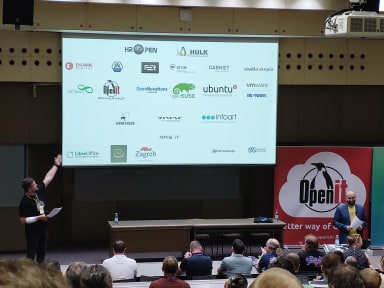
A Linux conference almost as old as Linux itself. In mid-May, DORS/CLUC hosted its 29th event at the Faculty of Electrical Engineering and Computing in Zagreb, Croatia. With a long history of participation and contribution to open source communities, Canonical was one of the sponsors at the conference, with a busy schedule that included a
An embedded device is a hardware and software system that performs a dedicated function within a larger computer system. It is typically resource-constrained and comprises a processing engine. The software of an embedded Linux system runs on top of the Linux kernel, the fundamental core of the OS with complete control over everything occ

Learn how Canonical improves security on Linux with live kernel patching. Track Livepatch activity over time in Landscape.
Welcome to the concluding chapter of this three-part blog series on the low latency Linux kernel for industrial embedded systems. Each blog is standalone and can be read independently from the others, although you may want to start at the beginning for some continuity. If you need a quick refresher on userland and kernel space,
Welcome to Part II of this three-part blog series on adopting the low latency Linux kernel for your embedded systems. In case you missed it, check out Part I for a brief intro on preemptable processes in multiuser systems and memory split into kernel and user space. The low-latency Ubuntu kernel ships with a 1000
Welcome to this mini blog series on the low latency Linux kernel for industrial embedded systems! The real-time patch, which is not fully upstream yet, has had many developers wonder about stable alternatives for their projects adopting an embedded Linux operating system (OS) with latency requirements in the milliseconds’ range. The low-

The future of financial services technology infrastructure is hybrid multi-cloud. Hybrid multi-cloud architecture provides financial institutions flexibility, portability, interoperability, and the control needed to consistently deploy and manage enterprise applications and workloads. By adopting hybrid cloud, finservs realise the benefit

Developers can now launch Linux instances on Apple M1 with Multipass 1.8 November 9th London, UK: On the heels of Apple’s announcement of a new line of game-changing M1 MacBooks, Canonical is bringing fast and easy Linux to the M1 platform. Multipass, the quickest way to run Linux cross-platform, received an update last week allowing

14 October 2021: Today, Canonical released Ubuntu 21.10 – the most productive environment for cloud-native developers and AI/ML innovators across the desktop, devices and cloud. “As open source becomes the new default, we aim to bring Ubuntu to all the corners of the enterprise and all the places developers want to innovate,” said Mark Sh

KVM (Kernel-based Virtual Machine) is the leading open source virtualisation technology for Linux. It installs natively on all Linux distributions and turns underlying physical servers into hypervisors so that they can host multiple, isolated virtual machines (VMs). KVM comes with no licenses, type-1 hypervisor capabilities and a variety