
Blog posts tagged "Ubuntu"

Ubuntu Server 20.04 LTS (long-term support) is here with enterprise-class stability, resiliency and even better security. As an LTS release, it will be supported by Canonical until 2025. However, customers can extend security updates by an additional five years through the ESM (Extended Security Maintenance) service as part of their UA-I

Well, here it is! Ubuntu is the world’s most popular open-source desktop operating system, and we think this is our best release to date. Ubuntu 20.04 LTS is an enterprise-grade, secure, cost-effective operating system for organisations and home users. Before I summarise the changes in this release, let’s address something I’ve seen discu
April 23rd 2020: Canonical, the publisher of Ubuntu, today announced the general availability of Ubuntu 20.04 LTS, with a particular emphasis on security and performance. “Accelerating open source globally is our mission. Ubuntu 20.04 LTS is the new state of the art open source platform for the enterprise and the entrepreneur,” said Mark
Creating a new release of Ubuntu is always a complex undertaking. At Canonical, delivering Ubuntu is our core mission, and each new version represents the culmination of months of effort from colleagues throughout our organisation – not to mention the contributions from our wider, open source community. And as our Bionic Beavers and Trust

When we launched Ubuntu back in 2004, our mission to make well-supported, free open source software available to everyone, everywhere was a bold one – but today, Ubuntu is one of the world’s most popular operating systems. One consequence of that popularity is that Ubuntu has very much entered the public consciousness, and its influence

The Robot Operating System (ROS) is a popular open-source platform for advanced robotics. Its flexibility and ease-of-use make it well-suited to a wide array of robotics applications – however, these robots are not always sufficiently protected against security threats. Opportunistic attacks are by far the most prevalent, and robots with

SBI BITS provides IT services and infrastructure to the SBI Group — Japan’s market leading financial services company group — which is made up of over 250 companies, and 6,000 employees. To increase time to market and meet heavy client requirements, SBI BITs was looking for alternative solutions beyond bare metal servers and decided upon

Interana, an analytics software provider, enables users to run advanced big data queries on raw customer data and delivers answers in seconds. Their customers include Microsoft, Comcast and Salesforce. Interana’s leading-edge platform is based on Ubuntu and deployed directly inside customers’ public cloud environments. This empowers users

Private cloud infrastructure remains an essential part of every enterprise nowadays. However, due to the increasing number of workloads and data, the overhead of managing bare metal servers, virtual machines and containers can mount up. Although tools like MAAS, OpenStack and Kubernetes help to address this problem, upskilling operations

Sometimes you really need a deterministic response time in your system. For example, a robotic arm that needs to be at the right place at exactly the right time, and you cannot avoid the need for a hard real-time (RT) operating system. But, that is only a small part of your software, and for the
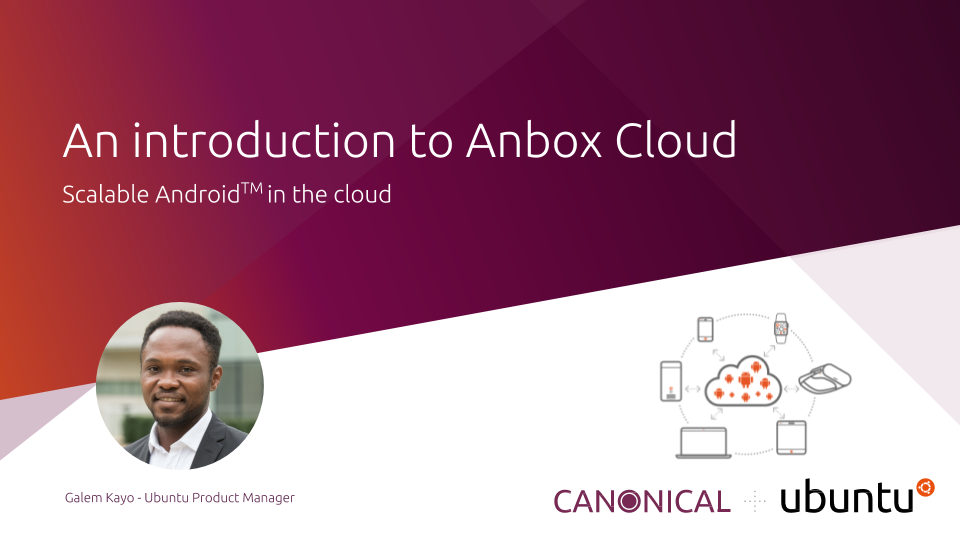
Anbox Cloud, Canonical’s recently launched platform, delivers Android at scale in the cloud. Leveraging Android as a guest operating system to virtualise mobile workloads on servers while streaming graphical output to clients, Anbox Cloud empowers innovators to create rich digital experiences on various mobile form factors. Delivered as s

Launching IoT devices and managing them at scale can be a time intensive and complex process. With 85% of IoT initiatives not launched after a year of development, it is inevitable that change is needed. To overcome these challenges, Canonical has introduced Smart Start, a package that reduces business and technical decision making into a

This is the third and the last guide in this series. In the first installment, we learned about considerations for an update from Windows 7 to Ubuntu, key differences in hardware and software between the two operating systems, the terminology, and how to safely backup data ahead of migration. In the second tutorial, we covered

Deploying AI/ML solutions in latency-sensitive use cases requires a new solution architecture approach for many businesses. Fast computational units (i.e. GPUs) and low-latency connections (i.e. 5G) allow for AI/ML models to be executed outside the sensors/actuators (e.g. cameras & robotic arms). This reduces costs through lower hardware

Installing an operating system is not an easy task. For most people, this is something they will never have done. The vast majority of people buy computers with the operating system already installed, so they never have to manually run through the system setup. The process can be intimidating, but we will try to make

Some time ago, Rhys Davies wrote a timely article, titled Why you should upgrade to Ubuntu. In it, he outlined a high-level overview of what the end of support of Windows 7 signifies for the typical user, the consideration – and advantages – of migrating to Ubuntu as an alternative, and the basic steps one